Sun, glare and privacy, window by window — written for the homes that actually stand under Lynnwood's jacarandas, not for a catalogue. Real sun angles, real Highveld climate numbers, and what we'd specify on each elevation, with the honest trade-offs both ways.
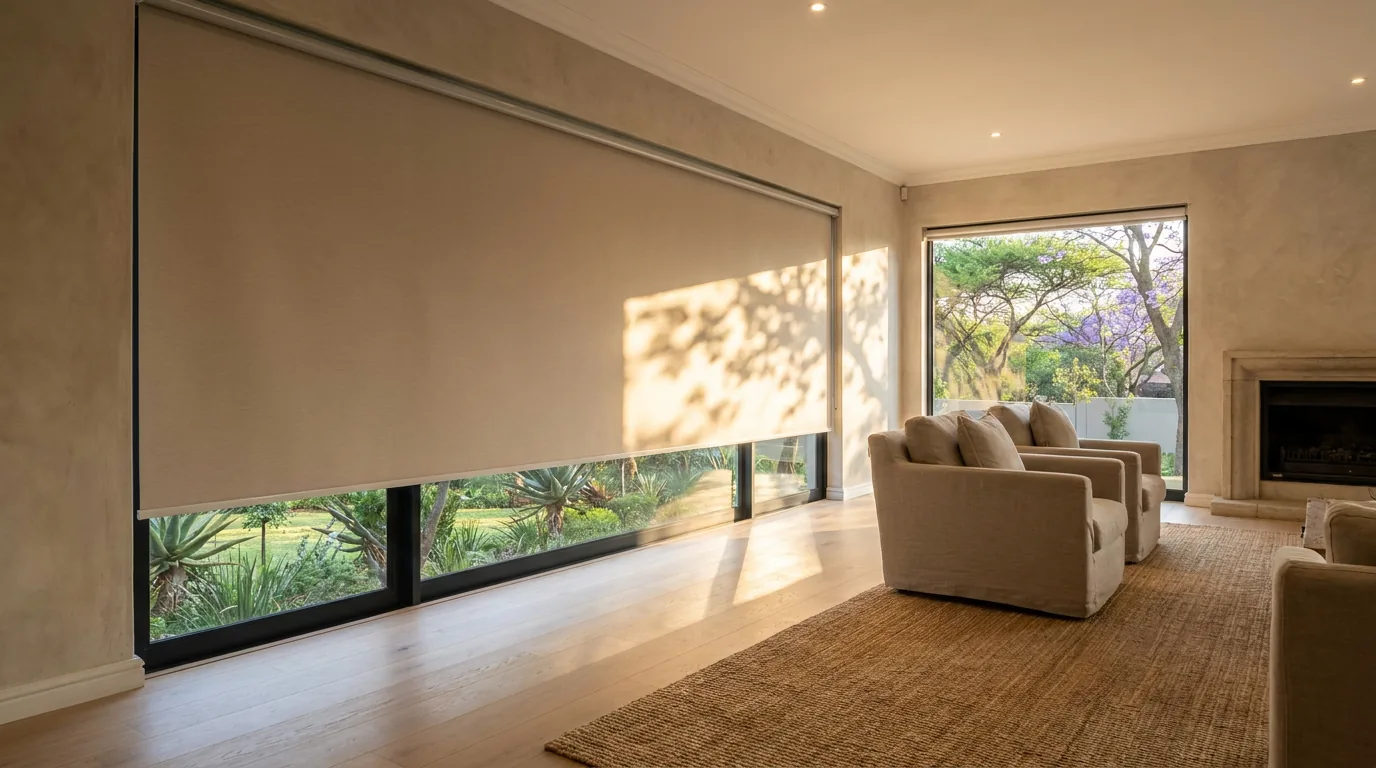
The three-o'clock problem, softenedA sunscreen roller cutting the glare on a west window without switching the garden off — the hour every Lynnwood quote is really about.
Most shading advice is written for nowhere in particular. This is written for a suburb at about 25.7° South, roughly 1,300 m up, where the December noon sun sits almost overhead and the June noon sun drops to 40° and slides in under the same eave that shaded it in summer. Lynnwood adds two problems of its own: a 1960s "Garden City" plan with no straight streets and no two roads parallel, so orientation can't be read off the map; and a jacaranda canopy that gives deep shade all morning, then lets a hard band of low west sun through the lounge by mid-afternoon. Everything below is sourced — the reference list is at the foot of the page.
One
Why Lynnwood is its own problem
Lynnwood was laid out from the 1960s as the then-easternmost suburb of Pretoria, and it was designed on purpose as a "Garden City" — no straight lines, no two streets running parallel, irregular flowing stands, wide grassed verges and small internal parks threaded through it.10 That single design decision is the reason a compass matters more here than in the grid suburbs next door: a lounge you'd swear faces the street can be pointing west, and the curving stand two doors down faces somewhere different again.
Over the top of all of it sits the jacaranda canopy. Pretoria is the Jacaranda City, with tens of thousands of trees that turn the streets lilac in mid-to-late October,14 and in a mature suburb like Lynnwood those trees do real shading work — deep, cool, dappled shade for most of the day. The catch is what happens when the sun drops below the tree line in the afternoon: it finds the lounge and patio glass directly, low and hard, from the west. Comfortable garden, comfortable morning, and then a punishing hour on the west side by three o'clock. That pattern — dappled, then a hard cut — is the spine of almost every quote we write in this suburb.
Two
The light here, by season
Pretoria sits at roughly 25°44′ South, about 1,300 m up on the Highveld, and the sun stays in the northern half of the sky all year.1 Four solstice numbers do most of the explaining:
Midsummer (Dec) noon: the sun stands at about 87–88° — almost directly overhead.1
Midwinter (Jun) noon: about 40°, due north — low enough to reach in under a normal eave.1
Midsummer the sun sets at about 243° — south of due west, so the summer afternoon sun swings west-south-west and stays low a long time.2
Midwinter it rises about 64° and sets about 296°, both north of the east–west line.2
The eave that shades a north window at midsummer noon does almost nothing in June. Angles from source 1.
Read it practically: the summer sun is the easy one and the winter sun is the sneaky one. At 87° a modest veranda shades a north window at midday in December almost by itself. At 40° in June the sun comes in under that same eave and reaches metres across the floor. And the low west afternoon sun is the expensive one — no overhang shades it, because it arrives from underneath and to the side.
Two Highveld facts then change the specification. UV rises roughly 10% for every 1,000 m of altitude,4 so at 1,300 m fabric fading and UV load are a year-round design factor rather than a summer-only one — helped along by Pretoria's roughly 3,200 hours of sunshine a year.5 The rain then arrives as sharp Highveld afternoon thunderstorms from about October to March, with hail concentrated in the December–January afternoon, broadly 13:00 to 17:00.7 That is exactly the window an awning is most likely to be out — and it's the single biggest reason we won't sell you outdoor shade without a wind strategy attached.
Three
Elevation by elevation
Take a compass to each room before assuming anything — on these curving Garden-City stands that isn't optional. Four cases, and a fifth for the trees.
North
Sun every day of the year
The good light — generous in winter, strong at the top of summer. The mistake is over-specifying: heavy blockout throws away free June warmth along with the glare. North wants something adjustable through the day, not a permanent off-switch.
West
The expensive elevation
From mid-afternoon the sun swings toward that 243° summer sunset and keeps dropping under the jacaranda line straight into the glass.2 Heat, glare and fabric fading land here together. This is the Lynnwood problem in one word.
East
Glare, not heat
The mirror of west, but against cool overnight air and cool masonry, so it rarely turns into a heat problem — it's a glare one. Breakfast rooms and east bedrooms taking direct sun early. Light control solves it far more cheaply than a west elevation ever does.
South
Calm, with a summer caveat
Even, indirect light — the right room for a desk. One caveat: December's sunrise and sunset both sit south of the east–west line,2 so a south room catches a raking hour of low sun at each end of a summer's day. In June, none at all.
And then: what the trees don't cover
The jacaranda cover that shades a stand at street level does nothing for a first-floor bedroom above the canopy, and nothing at all for a new double-volume glass wall or a stacking door added at the back of a renovated house. The common complaint is exactly that: a cool, comfortable ground floor, and one upstairs room or one new glass wall taking the raw version of everything in section two.
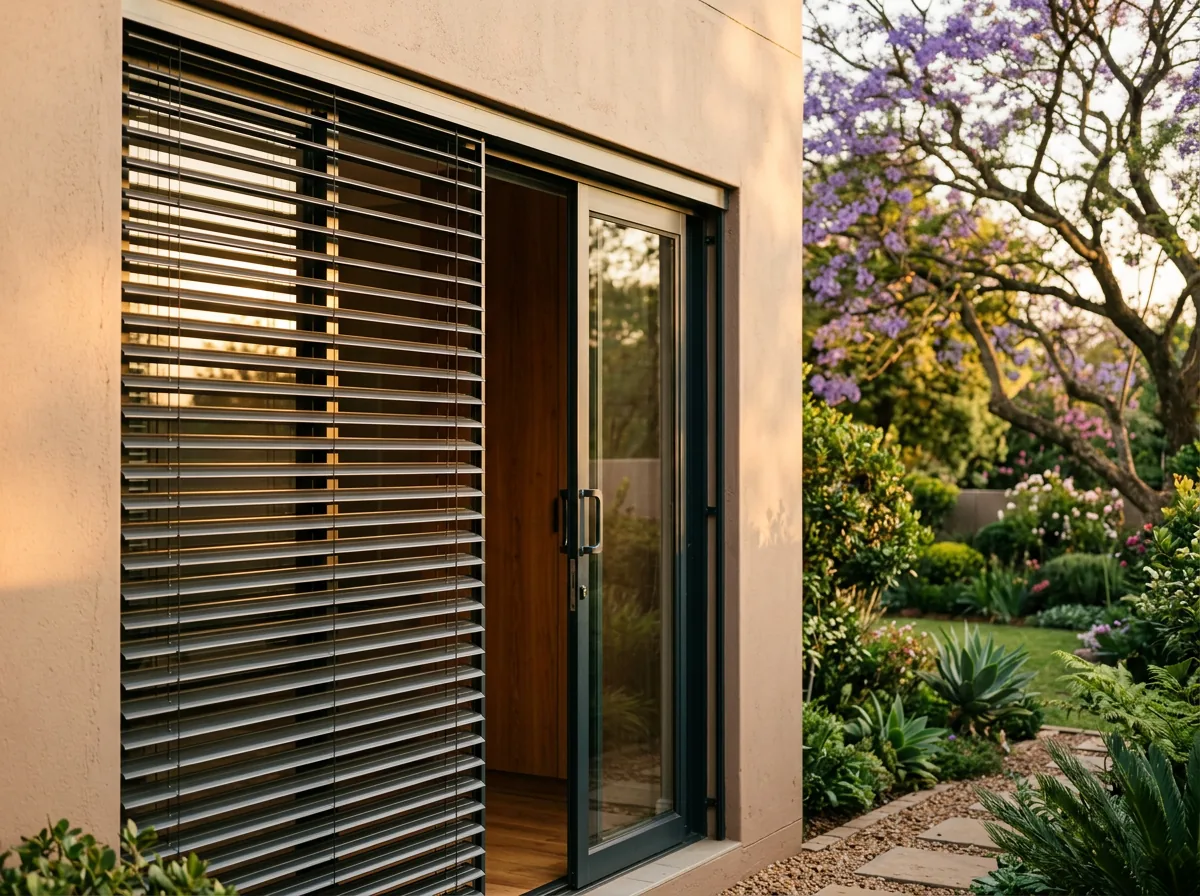
External venetians on a west patio door: the sun is stopped outside the glass, and the tilt keeps the garden view a rolled-down blind takes away.Four
What we'd specify, and why
Seven answers, each with its reasoning and its honest trade-off. Tap the ones that sound like your house — they carry through to the window schedule and the free-measure form further down, so you don't retype anything.
For a hard west lounge or patio door
External venetians, ahead of an interior blockout roller
The physics is the whole argument. Louvres outside the glass stop the sun before it reaches the pane; an interior blockout absorbs that energy once it's already through, so the fabric and the glass warm up and radiate it straight back into the room. You feel the difference most on exactly the west elevation Lynnwood struggles with. The tilt also keeps the garden view that a rolled-down blind takes away completely.
The trade-off, honestly: this is the more expensive route and it's a permanent fixing to the outside of the wall, so on a cluster or complex unit it usually needs body-corporate sign-off (section five). Where external isn't possible, a sunscreen mesh plus a blockout on a double bracket is the honest second best — less cost, meaningfully less heat control.
Where a venetian won't suit, or a room wants full dark and cool
Roller shutters — the other way to stop it outside
Aluminium slats rolling down from a headbox outside the glass. Closed, the slat curtain and the trapped air behind it shade and insulate together; half-lowered, it takes the top of a tall window and leaves the bottom clear. Often the better answer than louvres on a very large or high opening, or a room that would simply rather be dark and cool than keep a view.
The trade-off, honestly: it's position, not tilt — you're choosing how far down, not steering the light by degree. And to be plain: these are shading shutters, for sun, heat and glare — not security-rated shutters. That's a different product, which we can quote on request.
For north-facing lounges and living rooms
Sunscreen mesh, not blockout — keep the good light working
North light is the light you want; the job is to take the sting out, not switch the room off. An open-weave mesh around 5% openness cuts the glare and much of the UV while the garden stays legible through it. On the newer cluster developments, where a run of identical street-facing windows sits side by side, specifying the one fabric and colour across the whole elevation is what makes it read as a scheme rather than a row of separate fixes.
The trade-off, honestly: mesh gives daytime privacy only; after dark with the lamps on it reverses and you become the lit side. Where a room genuinely needs both, a double roller answers it — mesh in front for the day, blockout behind for the night.
For bedrooms
Blockout rollers — the reveal matters more than the fabric
Every blockout fabric is opaque, and almost no bedroom complaint is really about the fabric. It's light leaking round the edges. Fitted inside the reveal the blind sits neatly in the frame and you accept a hairline of light down each side; face-fixed over the opening it's far darker, at the cost of covering the reveal and the frame. On a west-facing Lynnwood bedroom that catches the three-o'clock sun, this is the call that decides whether a child actually naps.
The trade-off, honestly: no free option — inside-fit for looks, face-fit for darkness, or inside-fit with side channels for both at the cost of one more component. We'll show you all three at the window.
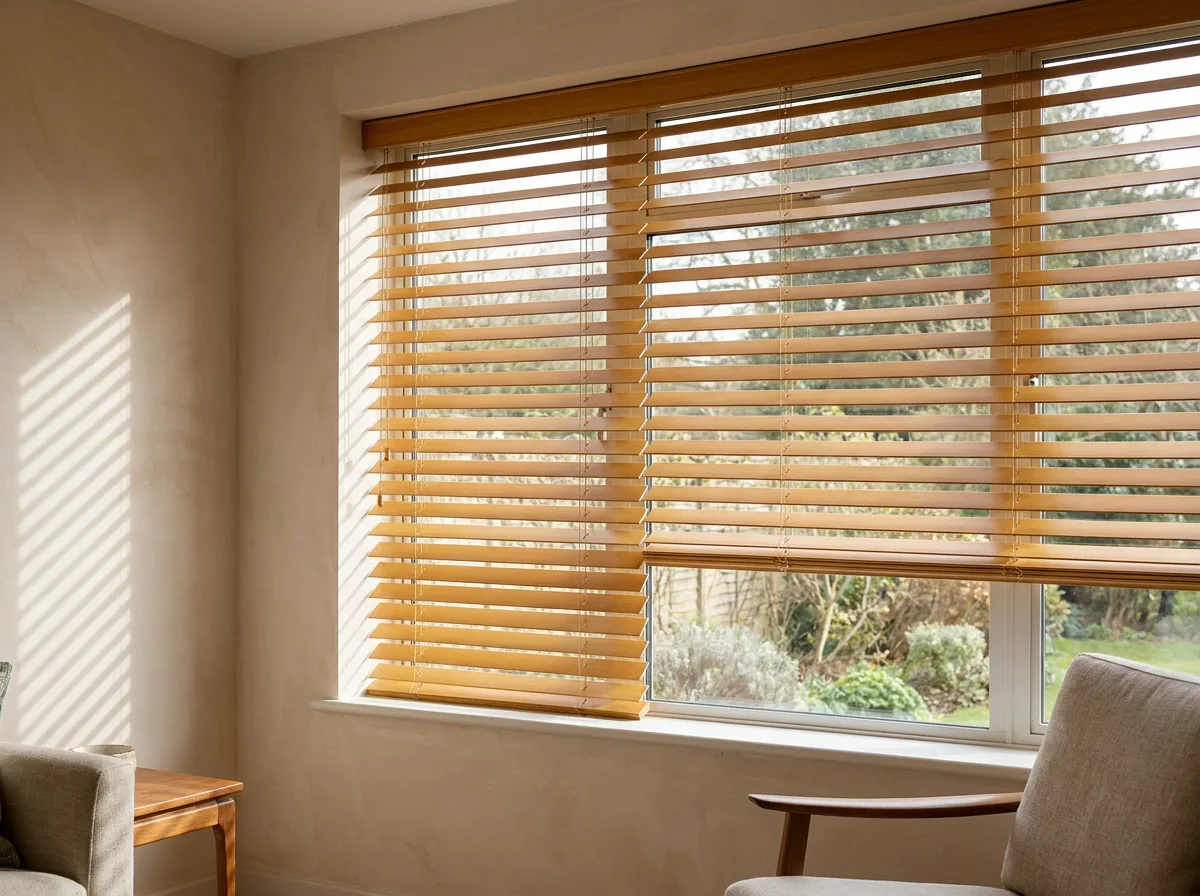
Timber venetians on an original steel-framed window: 50mm slats read at the rhythm of the old frame, tilting light without switching it off.
For the original steel and timber windows, and for rooms that are hard to heat
Timber venetians for the old frames; cellular where the cold is the problem
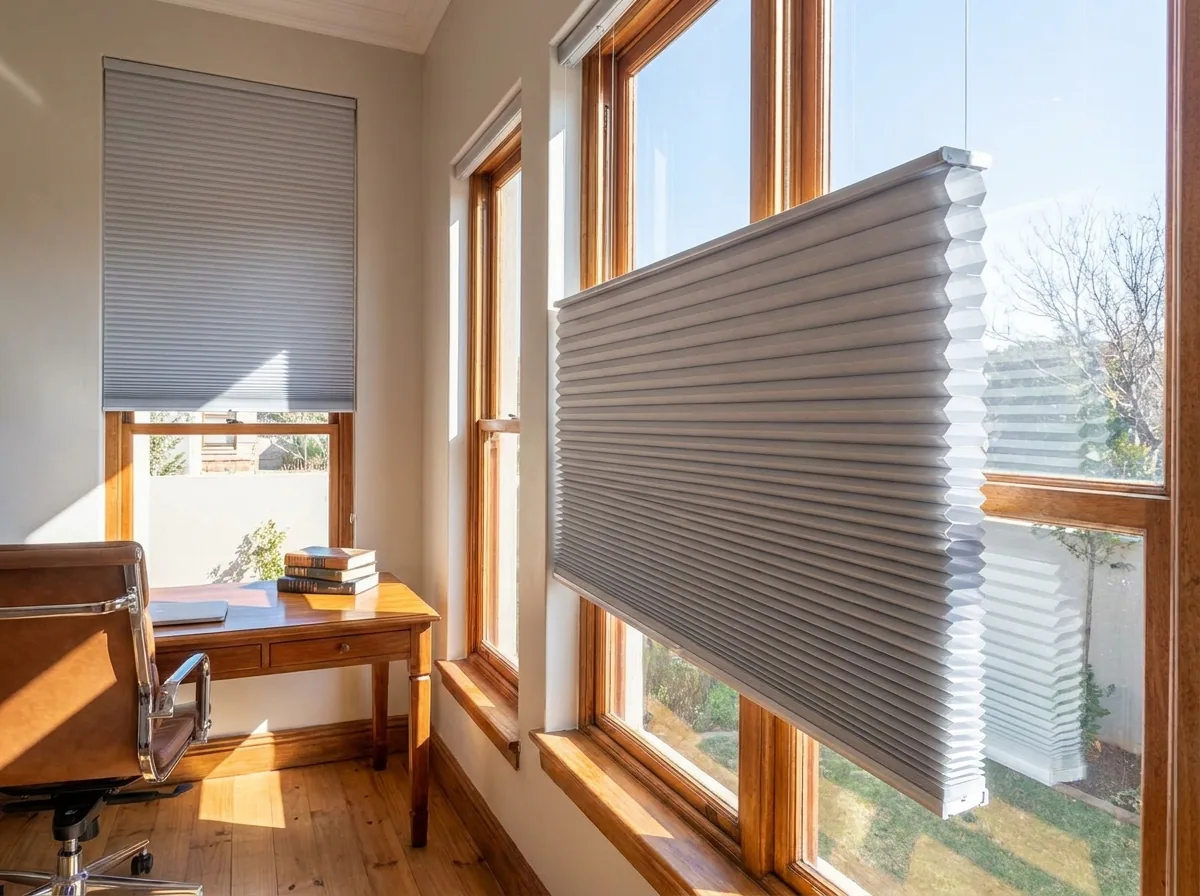
Many Lynnwood homes still carry their original 1960s–80s steel-frame and timber windows,13 and 50mm timber slats read at roughly the rhythm of those frames, so the window still looks like the one the house was built with. Tilt them upward and they bounce light off the ceiling, lighting a study without glare on the desk. Where the complaint is cold rather than glare — a room that bakes at three in January and freezes at six in July under Pretoria's dry, clear winter nights — a cellular blind is the better answer: the honeycomb traps air, and it's the trapped air that insulates.
The trade-off, honestly: timber slats collect dust and want the occasional wipe, and past about two metres wide we'd split the opening or motorise it. Cellular won't take scrubbing, so kitchens, bathrooms and sculleries get aluminium venetians instead — and cellular doesn't tilt, so it's insulation, not light-steering.
Cellular honeycomb on a study window: the air trapped in the cells is what softens both the January bake and the July chill at the glass.
For the patio and braai area, under the jacarandas
A folding-arm awning with a wind sensor — or a zip screen on a more exposed stand
Post-free shade that retracts suits this climate exactly: shade through the summer entertaining months, then the low winter sun back on the paving in July. Motorising it is the same argument one step on, and a battery tube means nobody chases cable across a finished patio. On a sheltered, hedge-lined Lynnwood stand an awning is the simpler answer; where the stand is more open, a zip screen — mesh tensioned inside side channels — copes with gusts an open awning arm can't.
The trade-off, honestly: awning fabric is a consumable, and battery tubes want charging once or twice a year. With hail peaking in the December–January afternoon,7 a wind sensor on an awning isn't an upsell — it retracts the fabric when nobody's home to do it. A zip screen fixed in channels has no such exposure, which is the honest reason to choose it on the open stands.
For the renovated back of the house, and for anywhere with children
Concealed blind boxes on the new glass; motorisation on the hard-to-reach and the child's room
Where a Lynnwood home has been opened up at the back with stacking doors, a concealed blind box drops the fabric out of a slim slot in the ceiling with every bracket hidden, so the new glass reads as pure glass. And almost everything in the range can be motorised — battery, rechargeable or wired — which earns its keep most on high stairwell windows, a double-volume glass wall, and any room a child uses, because there's no cord or chain to reach at all.
The trade-off, honestly: a concealed box is a build-or-renovation decision — hard to retrofit into a finished ceiling without opening it up, so it's a conversation for a project still on the drawings. Motorisation adds cost per window; we'd put it where reach or child-safety justifies it, not blanket the house with it.
Tell us which rooms or elevations are the problem and we'll send you a copy of this guide with notes written against your windows — which of the above we'd put where, and why. Same guide, read for your house instead of in general.
Thank you — that's on its way.
One of our expert consultants will send your marked-up copy of the guide, and will contact you shortly about the rest.
Five
Older frames, clusters & guest homes
Lynnwood is an open garden suburb rather than a heritage-permit zone, so there's no blanket architectural committee to satisfy the way there is on a century-old homestead elsewhere in Pretoria. What does come up here is more practical, and worth knowing before you order:
Inside the reveal is a furnishing decision. Outside the glass is a building decision.
A blind fitted inside the reveal is yours to choose freely. Anything fixed to the outside of the wall — external venetian rails, an awning cassette, a roller-shutter headbox, zip-screen channels — is a change to the outside of the building, and on the newer security complexes and cluster developments filling in around the older stands13 that's typically a body-corporate decision, with a rule that street-facing units match. The older freestanding homes have their own quirk instead: original steel and timber frames that are rarely perfectly square, which is a measuring problem, not an approval one.
A last one specific to this suburb: some of the larger older properties now run as guesthouses or lodges,13 and there the goal is usually a consistent scheme across a run of guest-room windows. What we'll do is specify slim profiles and quiet colours and supply the product data an application needs; what we won't do is call a body-corporate approval a formality, or submit it for you.
Six
What only a site visit answers
Everything above follows from a plan and a compass. These five don't, and any one of them can change the recommendation:
Reveal depth, at several points. The older steel and timber openings are rarely square, and the gap between a shallow and a deep reveal decides whether a headbox sits inside the frame or proud of it.
What's behind the plaster. Solid 1960s masonry, later brick-and-cavity, or a rebuilt stud wall at the renovated back — the substrate decides the bracket, and whether an external system is viable on that wall at all.
True orientation, room by room. On Lynnwood's curving, non-parallel Garden-City streets10 you can't read orientation off the road — and everything in sections two and three depends on it.
Wind and hail exposure at your specific stand. How much the jacarandas and walls actually shelter that patio decides an awning-with-wind-sensor versus a zip screen.
Where the power goes, and any complex sign-off. Whether a plug is in reach, whether a battery tube recharges without a ladder, and whether a cluster unit needs body-corporate approval for anything visible from the street.
That's the honest reason the measure exists, and why it's free: better to find these out before quoting than after fitting.
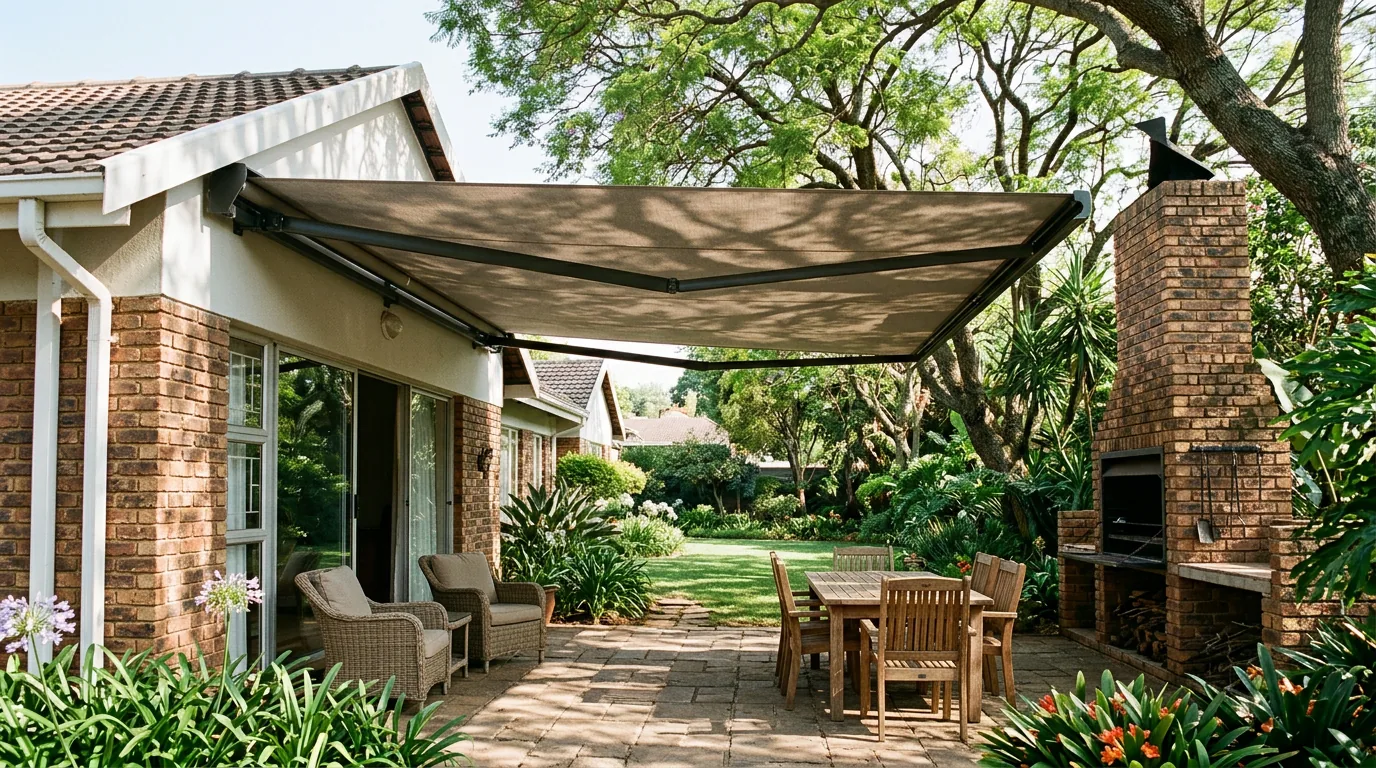
An awning over the braai, doubled up by the jacarandas — with a wind sensor, because the December hail arrives in the same afternoon hours it's most likely to be out.
Seven
Two ways forward — pick whichever suits you
One gets you an exact answer; the other a number to think about first. Both are free, and neither commits you to anything.
The straight answer
Book your free expert measure
A consultant comes with samples, checks the five things in section six, measures every window precisely and leaves you with a written, itemised, per-window quote. We take five or six measure appointments a week across this area, so the diary fills early — no charge, no obligation either way.
Thank you — that's through.
One of our expert consultants will contact you shortly to arrange your free in-home measure, with samples, at a time that suits you.
Or, first
Rather have a rough number before anyone comes out?
Pop in rough sizes on the window schedule below and we'll send a budget range by the next working day. No tape measure handy, or simply would rather not? Leave it — our consultant measures for free, and you'll get exact per-window pricing either way.
Plenty of people do both — rough sizes now, the free measure after.
Lynnwood Blinds — window scheduleWalk the house, fill this in, then type it in at lynnwoodblinds.co.za. Millimetres only, and it is the opening you measure — width first.
Your ballpark, in about two minutes
The window schedule
One line per window. Rough is fine — a tape measure and a guess to the nearest 50mm is plenty for a budget range. Nothing here is binding, and nothing is priced from it: the real number comes from the free measure.
Your rows travel up to the free-measure form and go off with your details — we come back with a budget range by the next working day. Rather not measure at all? Leave it blank and just book the free measure: the consultant measures for you, and you get exact per-window pricing instead of a range.
Nothing on this page is binding, nothing is priced from it, and nobody's going to phone you about a half-filled table. Print it, walk the house, come back to it whenever.
References
Sources
Every factual claim above about the sun path, the Highveld climate and Lynnwood's history and housing comes from one of these. Where a figure is a range rather than a single agreed number, the guide says so rather than pretending to more certainty than exists.
Kynoch Garden — Jacaranda City in Bloom and Your Neighbourhood — The Jacaranda City (Pretoria as the Jacaranda City, tens of thousands of jacaranda trees, main bloom mid-to-late October).
The full underlying research, including anything we could not independently verify, is logged at wiki/research/areas/lynnwoodblinds.co.za.md. Everything on this page — the sun-path diagram, the elevation notes, each product we put forward — is our own work and our own opinion, given free and with nothing owed on it.